

Login/Register



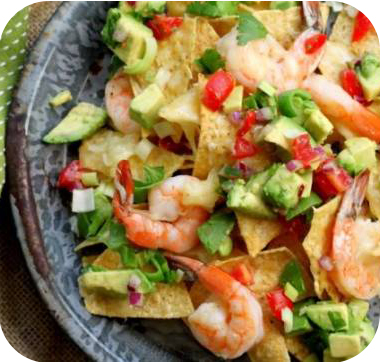
Shrimp and Avocado Salsa Salad
Description:
Shrimp and avocado salsa salad is a modern and unique dish whose delicious flavors are sure to impress your guests.
Red bell pepper (seeded and chopped) – 1
Green onions (chopped) – ¾ cup
Avocados (medium, peeled and chopped) – 2
Cilantro (chopped) – 1 cup
Shrimp (cooked and chopped) – 450 g (1 lb)
Tomatoes (medium, seeded and chopped) – 2
Cucumber (peeled, seeded, and chopped) – ½ cup
Lime juice – 3 tbsp
Green chili (seeded and chopped) – 1
Salt – 1 tsp
Black pepper – ¼ tsp
Crispy tortilla chips – as needed
Step 1:
Clean and wash the shrimp, then cook them. Chop the cooked shrimp and set aside. Chop the tomatoes and peel and chop the cucumber.
Step 2:
Peel, pit, and chop the avocados. Slice the green onions into rings. Wash and chop the cilantro.
Step 3:
Prepare a salad bowl and combine the cooked shrimp with all the chopped ingredients. Mix well.
Step 4:
Add lime juice, black pepper, red bell pepper, and salt. Mix thoroughly.
Step 5:
Garnish the salad with cilantro leaves and serve with crispy tortilla chips.


History and Methods of Fish Farming in Iran
The first activities related to fish farming in Iran date back to 1922 (1301 in the Iranian calendar), starting with the breeding and production of caviar-producing fish. Warm-water fish farming began in the 1960s (the 1340s in the Iranian calendar). Due to the high demand for farmed fish in Iran, today there are numerous fish farming centers across the country that breed and produce various species of aquatic animals using different methods.
Firstly, a bachelor’s degree related to fish farming is in the field of Natural Resources Engineering, especially in the Aquaculture and Fisheries specialization. Those interested in this profession can pursue this field for their undergraduate studies.
If you prefer a lower-level degree in fish farming, you can study in fields such as an associate degree in ornamental fish breeding and aquaculture and then begin practical work in this field. There are also courses in technical and vocational centers for training in fish farming.
It is important to note that after completing your studies, hands-on experience in fish ponds and farms, even for a short period, is highly beneficial and almost essential. This way, you can gain both scientific knowledge and practical experience in the profession.
Various aquatic animals, including fish, are cold-blooded, meaning they do not use energy to regulate their body temperature. As a result, they grow faster than other animals. This makes fish farming a highly profitable business. Among farmed species, trout, shrimp, and caviar-producing fish are considered the most profitable.
The choice of method depends on the type and species of fish. In general, fish farming methods fall into two main categories:
Cold-water Fish Farming
Warm-water Fish Farming
Breeding and farming in Danish earthen ponds
In tanks
In cement ponds
In floating cages
In enclosed coastal areas
In closed-loop systems
In agricultural irrigation canals
A) Extensive (subsistence-economic) method:
Fish breeding and farming in:
Water storage reservoirs (ponds and earthen dams)
Water sources behind dams
B) Semi-intensive fish farming:
Constructing earthen ponds for fish breeding
Building ponds above ground level
Excavating flat or gently sloped ponds
Excavating ponds with proper slopes
Integrated rice-fish farming
C) Intensive fish farming:
This method is generally applied in open ponds and closed (greenhouse) ponds, including:
Concrete ponds or non-earthen tanks
Floating cage farming
D) Fish farming in closed-loop systems
E) Aquaponics (integrated fish and plant cultivation)
Source: fardfishery.ir

Head of Iran’s Fisheries Organization: Per Capita Fish Consumption in Iran Below Global Average
The head of Iran’s Fisheries Organization stated that per capita fish consumption in the country is 13.8 kilograms, while the global average consumption is 20 kilograms.
According to Mehr News Agency, Seyed Hassan Hosseini said today, Wednesday, at the conference of Iran’s Fisheries Directors General in Lorestan, that last year, 8,300 billion rials were invested in the country’s fisheries sector. He added that 176 caviar farms are active in Iran, and 95% of caviar production has occurred after the Islamic Revolution.
He noted that Iran has numerous capacities to expand aquatic exports, which should be considered in operational plans.
Hosseini emphasized that efforts should be made to double the current production of aquatic animals, and in this regard, a fisheries atlas of the country has been prepared based on biological and provincial capacities.
Criticizing the multifaceted nature of decision-making in the fisheries sector over the past years, he said that provincial fisheries steering councils have been established to make decisions regarding production and consumption.
He added that over 33% of the organization’s programs focus on increasing productivity, and in terms of consumption, measures such as making fish more affordable, promoting awareness, improving distribution channels, direct marketing, and establishing specialized markets are planned.
The deputy minister and head of the Fisheries Organization also reiterated that per capita fish consumption in Iran is 13.8 kilograms, highlighting the gap with the world average of 20 kilograms.
Hosseini noted that 456 species of aquatic animals are farmed worldwide, while in Iran, the number is still less than 20 species. He stressed that national efforts are needed to close this gap.
He emphasized that managers should promote the importance of fish consumption, adding that awareness-raising is a national effort, and both large-scale and local specialized markets are very important. By promoting aquaculture culture, the middle and low-income segments of society should be encouraged to consume this protein.
Hosseini also highlighted the importance of completing the value chain in this sector, noting that Turkey is second to Iran in aquatic production but leads in exports, demonstrating the need to develop production clusters and the value chain.
He stated that Iran’s fisheries exports exceeded $600 million last year with a 9% growth rate, and with export-oriented products and economic justification, the goal is to reach $2 billion in foreign exchange earnings from fisheries.
He added that although shrimp farming in Iran broke a record last year with 61,000 tons produced, production must reach 200,000 tons, and achieving this goal requires the use of knowledge-based companies.
Source: www.mehrnews.com